

Why this article exists
A brand used to be kept coherent by the people who made its surfaces. Every screen passed through a designer, every sentence through a writer, and every release through a review. The work was slow, and the slowness did a job nobody had named: everything a customer saw had been touched by someone who knew what the product stood for.
That bottleneck is gone. Two machines now make a product's surfaces. At design time, an agent in a terminal writes the screens: it builds the flow, styles the components, drafts the copy, and opens the pull request. At runtime, a model inside the product writes the sentences: it explains a fee, composes a reply, and draws the interface itself, differently for each person and each channel. Both machines write well, and neither knows what the product must never say.
This article is about the layer that knows. Coherence means being recognizably one product on every screen, in every sentence, on every channel, in every language. It used to depend on discipline, and it now depends on architecture. The style guide that lived in a designer's head, or in a PDF nobody opened, has to become something machines can read and check: tokens, behaviors, contracts, profiles, and evaluations, kept in one governed place. That place feeds the agent that builds the product and the model that runs inside it. This article calls it an adaptive design system: a design system that lets generators adapt every surface while it holds the commitments.
One product runs through the whole argument. Corredor is a composite: a WhatsApp-native remittance product for Latin American corridors, built from patterns seen in real products so the examples can be concrete without pointing at anyone. Corredor shows up twice in every chapter that needs it: once as a product in front of a customer, and once as a codebase in front of the four people who build it. The doubling is deliberate, because the same system has to govern both.
Each chapter of the argument ends with a law: one sentence that can travel into a design review without the chapter attached. Long arguments rarely survive a roadmap meeting, and short ones sometimes do.
PART I
The Argument
Why coherence became an architectural problem.CHAPTER 1 · Part I
The Bottleneck Was the Brand
For most of the history of software, coherence was enforced rather than designed, and the enforcement was scarcity. Screens were expensive to make, so few people made them, and those few carried the brand in their heads. A style guide existed, but it worked like etiquette: a written reminder of judgments that were passed from person to person. When a company wanted more coherence, it hired more reviewers and slowed down. The brand lived in the bottleneck.
AI removed the bottleneck twice. First at design time: an agent working in a repository can produce a decent screen in minutes. Screens are no longer scarce, so the reviewers who used to see every surface now see a fraction of them. Then at runtime: a model inside the product composes sentences, and now interfaces, on demand, per person, per moment. No reviewer will ever see most of what a generative product shows its customers, because most of it does not exist until the moment it is shown.
What grows without the bottleneck is sprawl. AI features grow the way weeds do: a team adds one, and someone writes a prompt. The prompt works, so it gets copied into the next feature and edited a little. Six months later the product speaks with eleven slightly different personalities, none of them chosen. The design-time version of the same weed is the almost-component: every generated screen slightly different from its siblings. Each difference is defensible on its own, and together they are incoherent.
In 2024 a Canadian tribunal ordered Air Canada to pay for a bereavement refund its support chatbot had invented: the discount existed, but the chatbot promised it could be claimed after the flight, and the actual policy said otherwise. The airline argued, in effect, that the chatbot was a separate legal entity responsible for its own statements. The tribunal disagreed and held the airline to what its chatbot had said. Every generated sentence is a commitment made on the company's behalf, and every generated screen is a brand decision published without review.
- Core job
- Move money across borders without moving trust.
- Surfaces
- WhatsApp thread, web app, voice line, email, generated UI.
- Team
- Four people, one repository, agents doing the production work.
- Architecture test
- Can one governed system feed the agent that designs it and the model that runs it?
What is missing is a governed layer above both generators: one place where the product's identity lives in a form machines can read, loaded into context before anything is generated and checked against contracts after. The rest of this article describes that layer, what goes in it, and what it costs.
CHAPTER 2 · Part I
From Screens to Behaviors
When production gets cheap, the unit of design moves. This has happened before. Print designers specified pages. Web designers learned to specify templates, because the page count had become unbounded. It is happening again, and this time the move is bigger. When an agent can produce any screen on request and a model can rephrase any sentence per reader, the screen and the sentence stop being things you design. They are outputs. What you can still design is the behavior underneath: what the product is trying to do in this moment, what it must include, what it must never claim, and what a good outcome looks like.
| Old unit | New unit | Why it matters |
|---|---|---|
| Screen | Behavior | The surface is generated per person and per channel; only the behavior is stable enough to design. |
| Style guide | Governed context | Taste the generator reads before producing beats taste a reviewer applies after. |
| Handoff | Pull request | The design and its specification become the same artifact, one merge from shipping. |
| Brand review | Contracts and evals | Coherence gets checked by the system on every generation, not remembered by the team on some. |
The designer's job moves with the unit. Producing five plausible directions for a screen now takes minutes. Knowing which one is right, and why, is the craft that remains, and the whole system is organized around it. The machine generates options, and the human chooses, with reasons. A team that lets the machine choose, taking the first plausible output, has abandoned design rather than automated it.
Chat is where most teams first met a generative surface, but conversation is one renderer among several. The same behavior, explaining a delayed transfer, can show up as a chat reply, a status banner, an email, or thirty seconds of a voice call. A product that designs the reply has solved one surface. A product that designs the behavior has solved all of them, including the ones it has not shipped yet.
CHAPTER 3 · Part I
The Adoption Threshold
For many products, at many stages, building the full system in this article is a mistake, and not because the ideas are wrong. A three-screen prototype does not need behavior contracts. A product whose AI writes nothing riskier than a caption does not need an authority model. One person with good taste and a small surface can hold coherence in their head, which is where it has always lived most cheaply. A product without a coherence problem is buying insurance against a fire that is not burning.
The threshold is exposure, not company size, and exposure is two numbers multiplied: the cost of a wrong sentence, and the number of surfaces that can produce one. A solo designer shipping a marketing site is near zero on both. A brand file and a weekly critique are all that situation needs. A four-person team moving money through a chat thread is high on both, whatever its headcount, because a generative surface in a regulated category makes commitments at conversational speed.
So adopt one rung at a time. The first rung is a brand file the agent reads before generating anything. It costs an afternoon. Then tokens as the single source of visual truth, then extracted components with names, then contracts on the behaviors that can do harm, then evaluations, then traces. Each rung is useful without the ones above it, and each should be justified by a coherence failure the team has already had, not one it can imagine. The same logic applies to hiring. A team that wants a second designer usually wants the system instead: written taste, enforced tokens, a decision log. If none of that exists, a hire will not fix it, so build the system first.
There is a second axis, and it bounds the ambition rather than the timing. The full system assumes the product has a stable grammar: transfers, listings, statements, dashboards, the patterns that change slowly while everything above them adapts. Remittances have a grammar. So do banking, commerce, travel, and media. A product still searching for its shape does not, and modeling it too early does real harm, because the system will generate coherent variations of an assumption the team is not yet ready to freeze. For those products, take the low rungs, the brand file and the tokens, and leave the contracts until the grammar settles. Prototypes are how the grammar gets found: prototype freely, and let only the low rungs travel along. A model of a product is only as trustworthy as the product's claim to be settled.
There are also exit conditions, and they should be named early. If models become reliable enough that a plain instruction holds across a million generations, some of this scaffolding should come down, and Chapter 13 describes how to tell. An architecture should be able to say what would make it unnecessary.
PART II
The System
The artifacts a brand needs when models write its sentences and agents build its screens.CHAPTER 4 · Part II
One Source of Truth
Systems drift when their truth is stored twice. The traditional design stack stored it at least twice by construction: once in the design tool, once in the code, with a human translating between them. The two copies disagreed within a sprint of any release. The first structural decision of an adaptive brand is to collapse them. Tokens, components, screens, copy, and decisions live in one repository, and everything else, the style guide site, the exported specs, the agent's instructions, is generated from it. When the repository changes, the derivatives change. Nothing depends on someone remembering to update it.
Tokens carry the visual half of the truth, and their structure matters more than their format. There are three layers, and each answers a different question. Primitives name what exists: the palette, the scale, the type family. Semantic tokens name what things mean: surface, accent, warning, the vocabulary screens are built from. Component tokens name exceptions, and the fewer there are, the healthier the system. A generator styling a screen touches only the semantic layer. That is how a rebrand becomes an afternoon, and how a thousand generated screens stay siblings.
{
  "color": {
    "surface":  { "$value": "{color.cream.100}" },
    "ink":      { "$value": "{color.brown.900}" },
    "accent":   { "$value": "{color.gold.600}" },
    "warning":  { "$value": "{color.orange.600}",
                  "$description": "Reserved: fee changes, delays, holds." }
  },
  "space": { "flow": { "$value": "{space.4}" } }
}The semantic layer is the only one a generator may touch.
The other half of the decision is who the design system is for. It used to be documentation for people. Its first readers now are machines: the agent scaffolding tomorrow's screen and the model rendering tonight's answer both read it, and its quality is measured by what they do with it. A style guide site still matters, but as a human-readable view of a system whose native form is machine-readable. Both audiences read the same truth, which is the only arrangement where they cannot diverge.
The derivatives include the design surfaces themselves. The canvas, the prototype, and the product are three renderings of the same repository, at three fidelities. The canvas is generated for inspection: every screen and flow, laid out so a person can survey the territory and a stakeholder can review it. The prototype is generated for debate: real components, real behaviors, simulated data, close enough that the team argues about the experience instead of the picture. Production is the highest-fidelity rendering, bound to live services. Teams have always maintained these three by hand, and the three have always disagreed, because anything maintained twice drifts. Generated from one source, they cannot drift apart unnoticed. A canvas nobody regenerated is stale by definition. Designers at the frontier labs prototype on branches of the production app and share them as links. The third rendering is the one people reach for first.
The prototype has a second job. It is where the evals run: twenty generated variants of a flow, checked against the contracts before anything merges, in minutes. The canvas shows what the system believes, and the prototype tests whether those beliefs hold.
CHAPTER 5 · Part II
Semantic Components
Component libraries standardized the nouns of interface: Button, Card, Modal. Adaptive products need a vocabulary one level up, for the verbs. When a model decides how to respond and an agent decides how to compose a screen, the reusable unit is the behavior: Explain, Clarify, Confirm, Compare, Recommend, Repair, Warn. Each is a designed object, defined without reference to any particular surface. A Confirm names the facts it must present, the consent it must collect, the actions it may offer, and the evaluations that decide whether it worked. How a Confirm looks in a chat thread versus a web form is a rendering question, and rendering comes later.
Behaviors cut across the structural hierarchy instead of replacing it. Tokens compose into components, components into screens, screens into flows: that axis says what the product is made of. The behavior vocabulary says what the product is doing. A screen is where the two axes meet: a structure, rendering one or more behaviors, in one channel, for one moment. Model only the structure and every new channel is a redesign. Model only the behaviors and nothing can be drawn. The repository holds both, and the generators read both, which is how the same flow can be surveyed on a canvas and spoken in a WhatsApp thread without either version being the original.
The vocabulary is discovered in the work, and the reliable moment is the second flow. The first flow produces candidates. The second shows which parts recur, because the agent, asked to build it, will reproduce the first flow's patterns almost correctly, and the almost is the signal. At that point the team audits the inconsistencies, promotes the recurring patterns to named components, and replaces the inline variants with the canonical ones. Name components by what they do, never by how they look: a TransferSummary survives a redesign, a BlueFeeCard does not.
export const ConfirmTransfer: SemanticComponent = {
  intent: "Collect informed consent for a money transfer",
  requiredFacts: ["amount", "rate", "fee", "arrivalWindow"],
  allowedActions: ["confirm", "edit", "cancel"],
  consent: "explicit-question",
  forbiddenClaims: ["guaranteed arrival time"],
  repair: "RepairTransferDetails",
  evals: ["consent-is-explicit", "fee-before-consent"],
};Once behaviors have names, everything downstream gets simpler. Prompts stop describing what a response should be like and start naming what it is. Evaluations attach to behaviors instead of prose. And the two generators finally share a vocabulary: the agent composes screens out of the same Confirm the runtime model speaks in a chat thread. That is the first payoff of governing one system instead of two.
CHAPTER 6 · Part II
Brand as Governed Context
Ask a team what their brand voice is and someone will say warm but professional, and everyone will nod, and no two people will mean the same thing. That was survivable when every sentence passed through a writer. It is fatal when sentences are generated, because a model given warm but professional will decide for itself what warmth means at three in the morning to a customer whose transfer is stuck. The brand has to move from adjectives to constraints: written down, versioned, and loaded into every generator's context before it produces a word.
The written form has two halves. The first is the brand file: voice, tone by context, and the never-say list, which does the most work of the three. Each entry is a commitment: a sentence the product will not produce, in any language, on any surface, no matter how fluent it would sound. The second half is the contract, which is what the brand file compiles into. A conversation contract bounds what a behavior may say: allowed facts, required disclosures, forbidden claims, output shape. The brand file teaches the generator, and the contract checks its work.
## Voice
Plain, warm, direct. Money talk is calm talk.
Short sentences around numbers. No exclamation
points within two sentences of an amount.

## Tone by context
- Delay or hold: lead with what is true now,
  then the next step. Never open with an apology.
- Success: quiet confidence. One sentence.

## Never say
- "Oops" or "Uh oh" anywhere in a payment flow
- Any arrival promise not present in the
  rate object ("guaranteed", "instantly")
- "Trust us"export const DelayExplanation: ConversationContract = {
behavior: "Explain",
allowedFacts: ["status", "holdReason", "nextStep", "eta"],
requiredDisclosures: ["etaIsEstimate"],
outputShape: ["status", "holdReason", "nextStep", "etaIsEstimate"],
forbiddenClaims: ["blame-customer", "guaranteed-eta"],
onValidationFailure: "degrade-to-template",
};What makes this maintainable is that the same files serve both machines. The agent reads the brand file before drafting copy at design time. The context compiler loads it, with the contract, before the runtime model explains a delay. One edit to the never-say list reaches every future screen and every future sentence. That is what it means for a brand to hold by construction rather than by review. There is now a measurement. Vercel published the file its agents read, design.md, beside a stylesheet of the system's primitives, and measured the pair: 57% fewer documented failures across seven scenarios and more than two hundred runs. The stylesheet takes decisions away from the model, and the file explains the ones that remain.
CHAPTER 7 · Part II
Every Surface, One Promise
Cross-platform used to mean responsive: the same layout, gracefully squeezed. An adaptive product faces a harder version, because its surfaces do not share a layout to squeeze. A behavior renders as a chat message, a form, an email, a voice turn, or an interface composed on the spot. What holds these together is the promise underneath: the same facts, the same disclosures, the same actions, wearing whatever clothes the channel requires.
The instrument is the renderer contract, and the useful analogy is accessibility testing. Nobody tests a screen by asking whether the disclosure exists somewhere in the markup. They test whether a person using a screen reader actually encounters it. Renderer contracts make the same demand of every surface: the fee is stated before the confirm control can be reached, the warning is as prominent as the risk is serious, the cancel action is never more than one step away. The contract tests placement and reachability, not presence. A rendering that cannot meet the contract on some channel does not ship on that channel, and every behavior carries a deterministic fallback layout for the day the generative path fails. The fallback will be plain and correct, which is the right floor for a product that moves money.
Language is the other axis, and it is behavioral before it is lexical. Translating strings is the last step of localization. A conversation profile localizes behavior: pacing, directness, formality, which examples land, how consent is asked. The words change with the locale file, and the disclosure does not change at all. Copy itself is tokenized like color, stored as semantic keys with per-locale values, so the agent generating a screen and the model generating a sentence draw from the same vocabulary in every market.
CHAPTER 8 · Part II
The Control Plane, Twice
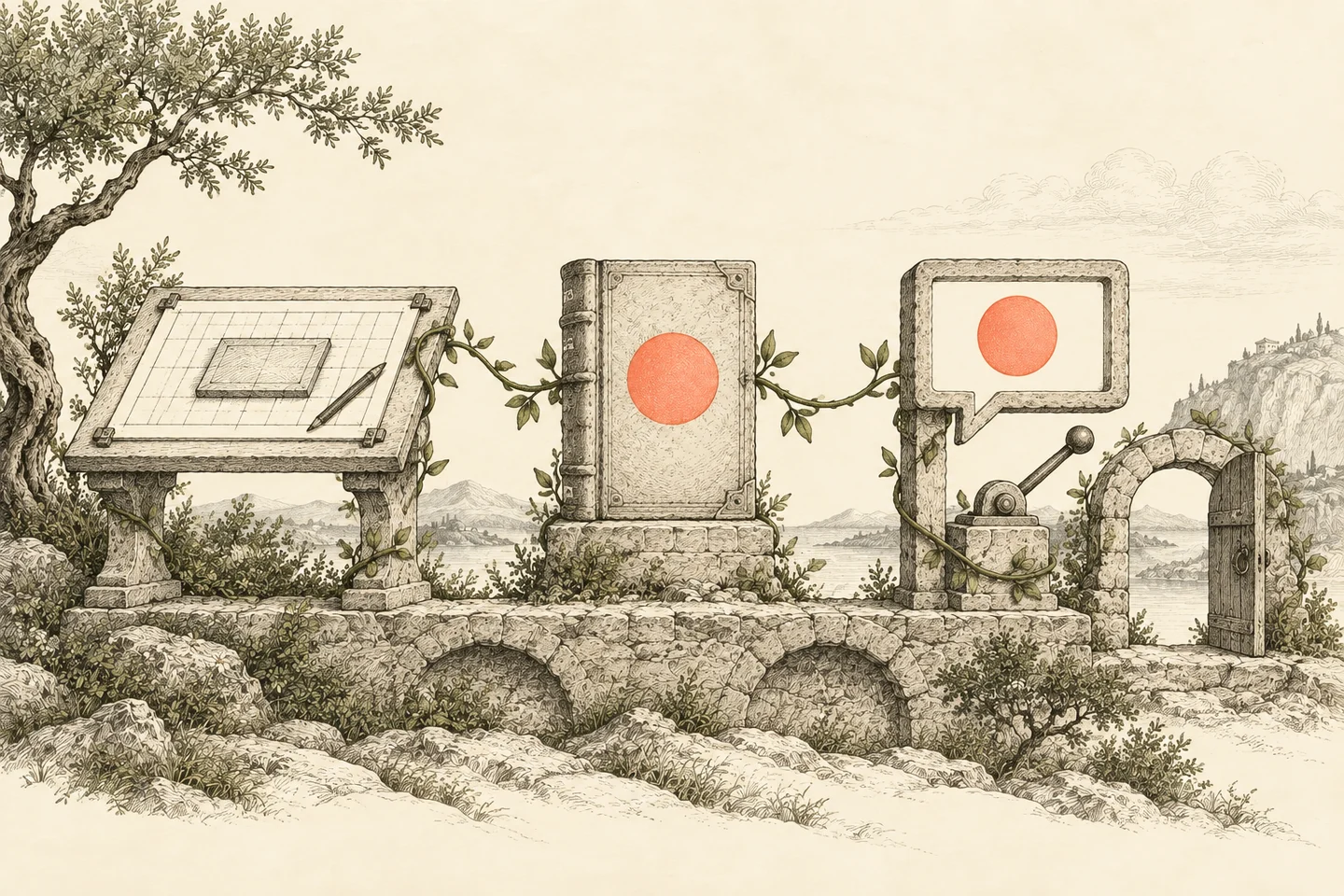
All these artifacts meet in a control plane: the governed layer that decides, for each piece of work, what context is admitted, which capabilities are available, which policies apply, and what evidence is kept. A well-run adaptive product builds it twice, in the same shape, at two different moments. The two versions differ in stakes and in dress, but every component in one has a counterpart in the other, because both solve the same problem: a fluent generator that must be briefed before it works and bound while it works.
| Function | Design time (the repo) | Runtime (the product) |
|---|---|---|
| Brief the generator | Agent instructions and skill files, compiled per task | Context compiler admitting facts with provenance |
| Bound the actions | Review gates, branch rules, protected paths | Action contracts and the authority graph |
| Check the output | Hooks, audits, and evals on the diff | Validators on the rendered turn |
| Keep the evidence | Decision log, changelog, git history | Replayable traces of every governed turn |
The design-time plane is the humbler one, and it is where most teams start. It is the repository itself, made legible: an instruction file stating what the project is and what may never happen, skill files carrying the brand and the patterns, and hooks that check the invariants on every change. The split between instructions and hooks matters because an instruction can be forgotten and a hook fires every time. Preferences belong in the instructions, and invariants belong in the hooks.
Both planes face the same editorial question: what gets admitted. The answer is a rule: context is admitted for the decision it changes, and anything that changes no decision is weight. Everything admitted carries provenance, so a claim can be traced to the artifact that made it, and a confidence, so the generator knows the difference between what the system knows and what it guesses. The system also declares what it does not know. A behavior that reaches a declared unknown degrades to the fallback, plain and correct, instead of improvising, and files the gap where the team will see it. An unknown the system admits is a backlog item, and one it papers over is an incident.
The runtime plane is the same idea with higher stakes. Before a model speaks, the compiler assembles what it may know, the authority graph limits what it may do, contracts bound what it may say, and a trace records what happened, so any turn can be replayed when someone asks why. Neither plane is the agent, and neither is the model. The generators are tenants in a building the plane provides, and the two buildings share their main walls: the same tokens, the same brand file, the same behaviors, the same evaluations. Maintain them as one system and you pay for coherence once, then collect it at both moments.
PART III
The Practice
Operating the system, week over week, without losing it.CHAPTER 9 · Part III
A Flow, End to End
Before the practice comes apart into disciplines, watch one week of it run. The Corredor team is adding scheduled transfers: a sender sets up a recurring payment to arrive before her mother's rent is due. One designer carries the whole flow, and the system carries everything the designer should not have to.
One flow, from brief to governed behavior, as the system sees it.
- Compile contextThe agent loads the instruction file, the brand skill, the token set, the behavior vocabulary, and the decision log before generating anything. The brief is one paragraph; the context is the accumulated system.
- DivergeFive directions for the scheduling screen, generated in minutes, all drawing on semantic tokens and existing behaviors. Divergence is the machine's job, and five is the floor, because a single option can only be accepted, not chosen.
- ConvergeThe designer picks the second direction, folds in the calendar treatment from the fourth, and writes two sentences on why. The sentences land in the decision log. Convergence stays human.
- Complete the behaviorHappy path, empty, error, loading, and the 375-pixel screen, before the flow is called done. States skipped at design time become improvisations at runtime, made by whichever generator gets there first.
- Bind the contractsScheduleTransfer joins the behavior vocabulary: required facts, consent shape, forbidden claims, a repair path, and the deterministic fallback layout for every channel it will render on.
- AuditThe accessibility pass runs its two layers, scanners for the mechanical failures and the agent for judgment calls. The fee-before-consent eval runs against twenty generated variants of the flow. Two fail, and the team tightens the contract instead of the prose.
- Open the pull requestThe diff is the design, the description is the brief, and the decision log entry is linked. Engineering reviews integration and performance. Nobody translates anything.
- TraceThe feature ships behind the runtime plane. Every scheduled-transfer conversation now compiles the same brand file the agent read on Tuesday, checks the same contract, and leaves a replayable trace.
On Friday a customer named Maria schedules rent for her mother in Oaxaca from a WhatsApp thread. The reply she gets is warm, short, states the fee before asking for consent, and promises nothing the rate object does not contain. She never sees the machinery.
CHAPTER 10 · Part III
Evaluation-Driven Design

Taste that stays in a designer's head does not scale to generators, because generators cannot read heads. The fix is an old one, the design critique, made continuous and partly mechanical. Every substantial piece of work gets options before commitment, a structured critique against written criteria, and a scheduled second look after it ships. What changes is who participates. The agent can run the critique too, against the brand file and the pattern library, and a different model makes a good second reviewer because it shares none of the first one's habits.
Under the critiques sits the harder discipline: writing the taste down as evaluations. An eval is a rubric made executable, attached to a behavior rather than a prompt. Does the explanation state the fee before the consent control appears? Does the recovery message avoid opening with an apology? Is the warning as prominent as the money at risk? Each is checkable across a hundred generated variants, which is the only scale at which checking now matters. Product metrics complete the loop but cannot start it: metrics decide winners, evals decide entrants. A variant that converts well while breaking a disclosure rule is an incident with good numbers.
The grader has changed shape, and it changes what an eval can cost. A rubric line is a bounded question, and a new class of model answers bounded questions without writing anything: state in, a typed decision out, with a probability the software can act on. TypeSafe's Jev, in early access in 2026, returns a choice, a score, or a yes or no in a fraction of a second, for a fraction of what a language model charges. It cannot explain itself, which is why it grades and does not critique. But it makes the hundred-variant check routine rather than heroic, and it turns the threshold into a real number: below this confidence, a person looks. Writing stays with the language model, and the verdict moves to the decision model.
Call the two kinds floors and dials. They organize all brand measurement. The on-brand score is a dial, and it should climb as the voice artifacts and their evals improve. The brand commitments are floors: the claim that is never made, the register that never appears, the disclosure that always does. Dials chased without floors corrupt. The fastest way to raise a conversion dial is to warn less and hedge less. Write the taste down as dials and the commitments as floors, and never let a dial override a floor.
Floors and dials also settle the question this system raises most often: whether written taste kills invention. A generator that produces a coherent answer in minutes makes the settled pattern the path of least resistance, and a team can stop looking without noticing it stopped. The countermeasure is to make the exception an artifact of its own. An experiment names the dials it suspends, the surface it runs on, and the date it ends. It may suspend any dial. It may never suspend a floor. The promotion path is explicit: exception, then candidate pattern, then named behavior with contracts and evals of its own. The system records what it does not yet believe.
## ConfirmTransfer / consent-is-explicit
Fail if consent is collected by any control
whose label does not name the action and the
amount ("Confirm $200 to Rosa").

## Explain / no-blame-opening
Fail if the first sentence attributes the
delay to the customer, in any phrasing.The rubric is now a design deliverable. A designer who can say why a direction is right, in criteria precise enough to run, has written down the scarcest thing they have. Everything else in the system exists so that those criteria, once written, get applied everywhere.
CHAPTER 11 · Part III
The Memory of the System
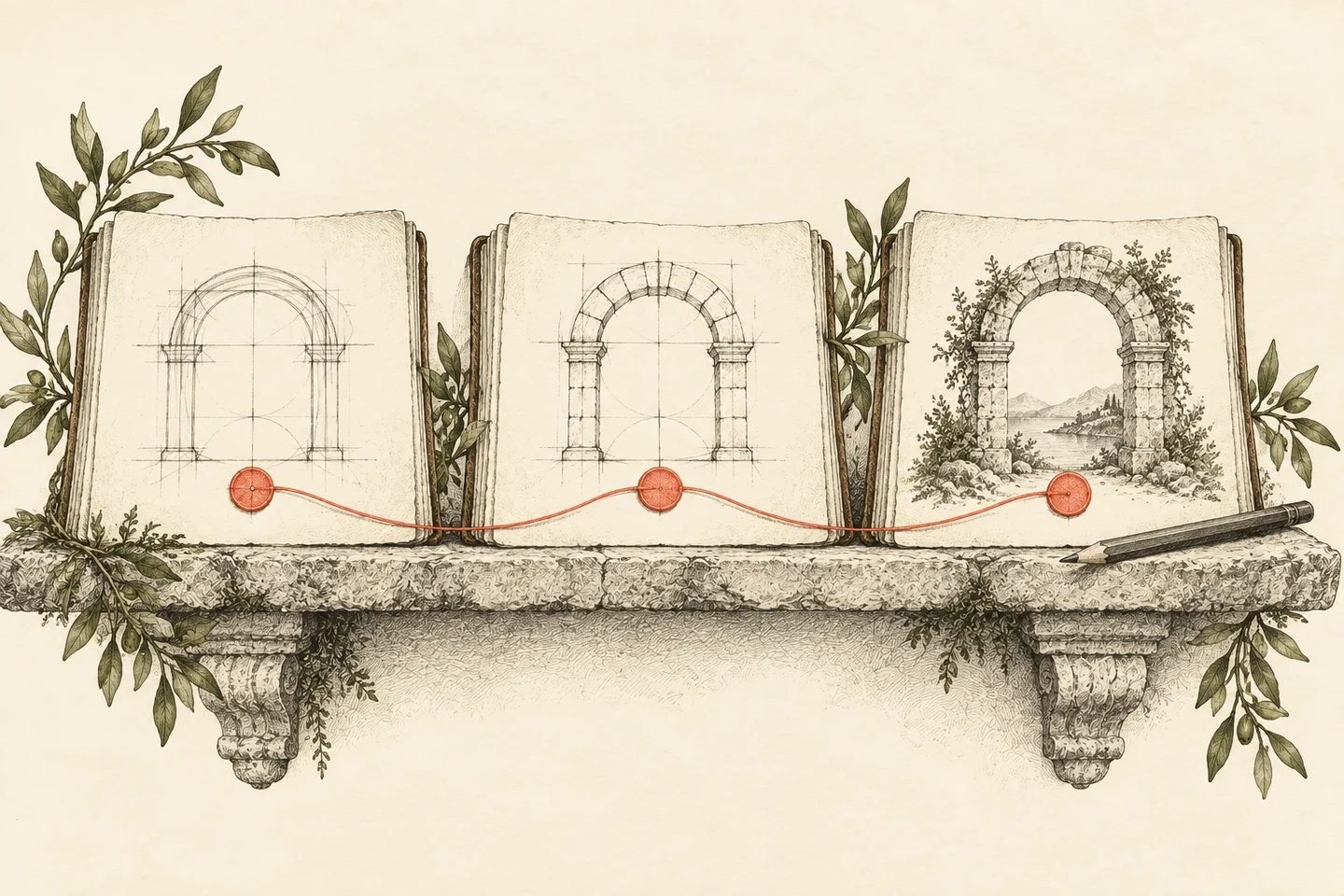
Technology scales through abstraction, and teams scale through memory. Every design decision of consequence gets made once, forgotten, and made again by someone else, slightly differently, and the drift between the two answers is where incoherence enters a growing product. The countermeasure is a decision log, kept in the repository, written at the moment of choice. What was decided, what was rejected, and why, in two or three sentences. The log holds the design's reasons, the part the artifacts cannot carry.
### 2026-06-19 -- Fees shown as totals, not itemized
Chose a single all-in fee line on every summary.
Rejected itemization: it tested as more honest but
read as more expensive, and support tickets rose.
Sign-off: brand + compliance. Revisit if corridors
with tax line-items launch.The log gets used twice. People check it when a settled question comes back, which happens about every six months in any team with turnover. The agent checks it before every generation, which is how a new flow inherits last quarter's reasoning without anyone re-explaining it. In practice the log becomes the onboarding: a new designer who reads the decisions, the brand file, and the behavior vocabulary has absorbed the team's taste in an afternoon, because for once it is written where the work happens.
Governance follows the same principle at team scale. Ownership attaches to artifacts: someone owns the tokens, someone owns the behavior vocabulary, someone owns the contracts that carry legal weight, and the review gates say which changes need whose eyes. The rest stays loose on purpose. Standardize the artifacts, not the tools, and let each designer keep whatever harness makes them fast. Everything of value lives in the files they all share.
Currency is the other half of memory, and it cannot rest on diligence. The rule is mechanical: a change to the product that does not change the system does not merge. A new behavior brings its eval binding, a new market rule brings its profile entry, and a new pattern brings its name in the vocabulary, all in the same pull request, checked by the same hooks that guard the tokens. Ownership says whose review the change needs, and the loop makes sure the change happens at all. Kept this way, the system is wherever the product currently is, because the product cannot move without moving it. The loop gets assembled over time: each hook began as a failure the team refused to have twice, and the next chapter watches one being born.
CHAPTER 12 · Part III
Breaking It on Purpose
Every example so far resolved cleanly, and that should make a skeptical reader suspicious. So this chapter breaks the system, with a failure built entirely from defensible decisions. A designer, moving fast on a Friday, lets the agent converge on a redesigned summary screen without the options pass. The screen is lovely. The agent, drawing on an older pattern, places the all-in fee below the confirm control instead of above it. The fee-before-consent eval would have caught it, but the eval is bound to ConfirmTransfer, and the new screen introduced a ConfirmScheduled variant nobody registered. The pull request is small, the reviewer checks performance, and the screen ships. For eleven days, on one surface, in one locale, Corredor collects consent before stating its price.
Every system fails, and generative ones fail faster. What the architecture bought is the shape of the failure: small and legible, because it spent all its effort making it so. The breach was one behavior variant on one surface, not a personality drift across the product, because everything else was contract-bound. It was found in an audit sweep, not a courtroom, because the weekly screen-level pass walks surfaces the unit evals cannot see. And the trace answered why in minutes: the variant, the missing registration, the skipped options pass, each visible, each fixable at one point. The postmortem produced a rule, the rule became a hook, and the hook now fails any pull request that adds a behavior without an eval binding. An instruction would have asked the team to remember, and the hook removed the option of forgetting.
The system promises local failure: one contract, one variant, one surface, one fix, instead of a diffuse off-brand-ness nobody can locate. A team that cannot say where a failure would show up does not have an architecture yet.
PART IV
The Test
The case against, and what survives it.CHAPTER 13 · Part IV
The Case Against
Models improve every few months, and much of what this article proposes is compensation for their current weaknesses. Contracts exist because instructions do not reliably hold. Evals exist because judgment does not reliably transfer. Fallback layouts exist because generation sometimes fails. Each artifact is scaffolding around a limitation, and scaffolding around a shrinking limitation is a depreciating asset. The objection has a name in machine learning: the Bitter Lesson, the field's old warning that handcrafted scaffolding loses, eventually, to general methods and more compute. A team that spends a year building the full apparatus may spend the next one maintaining machinery the models have made unnecessary, while a rival that waited writes better instructions to a better model.
Part of that is right, and the answer is to plan the retirement rather than deny it. Every layer should carry a sunset condition: the observable fact that would make it removable. When a plain instruction holds across a million generations, retire the contract that duplicates it. When the model's judgment matches the rubric nine hundred ninety-nine times in a thousand, thin the eval to a sample. Review the scaffolding on the same cadence the models improve, and feel no sentimentality when a layer comes down. OpenAI said as much when it shipped Codex: on its own benchmarks the model performed well without AGENTS.md files or custom scaffolding at all. Architecture must earn its keep on the models' cadence, not the calendar's.
But the objection proves less than it seems to, because it confuses two kinds of artifact. The scaffolding compensates for the generators, and it will depreciate as they improve. The commitments compensate for nothing. What the product promises, what it must disclose, what it may never claim, whose consent it needs, why the fee is shown as a total: no model improvement makes these decisions for a company, because they are choices, not capability gaps. Better models make expressing them cheaper and enforcing them lighter, and leave the deciding where it was.
The same logic settles the tooling anxiety. Harnesses, models, and vendors churn fastest, which is why nothing of value should live in them. If the favorite tool disappeared tomorrow, the team should lose a driver, not the brand, the decisions, or the taste. Everything in this article passes that test, because everything in it is a file in the team's own repository.
CHAPTER 14 · Part IV
The Discipline
The design system analogy carried this argument most of the distance. Here is where it ends. Visual design systems asked for consistency: the same button, the same blue, the same spacing, everywhere. An adaptive brand asks for something harder, because its surfaces are not supposed to be the same. They are generated per person, per channel, per moment, in whatever language the customer thinks in. Buttons needed consistency. Generative products need coherence, and coherence is what holds while everything else adapts. A design system that can do that, hold the commitments while generators move everything around them, has earned a different name. It is an adaptive design system, and this article has been assembling one all along.
What holds is short enough to list: the commitments, written as contracts; the taste, written as evaluations; the meaning, written as behaviors; and the truth, written once, in a repository both generators read. Around that fixed core, everything is allowed to move: the words, the layouts, the pacing, the channel, the model, the harness, even the team. The discipline is refusing to let the two categories blur, because every incoherent product fails the same way: something that should have been governed became something that merely tended to be true.
Fluency will not distinguish the next generation of products, because everyone's model will be fluent, everyone's screens will be competent, and both will be cheap. Products will be distinguished by whether they can adapt everything and still be recognizably, accountably themselves: one promise, kept on every surface, in every language, by generators that never met the founders. That quality has to be built into the system, because review cannot add it afterward.
PART V
Appendices
The laws in one place, and the artifacts worth stealing.Appendix A
The Laws
Every law from the preceding chapters, regrouped by what it governs. They are meant to travel without the chapters attached.
The argument
- Generate every surface. Govern one system.Preface
- What the bottleneck enforced, the system must now guarantee.Chapter 1
- The screen is an output. The behavior is the design.Chapter 2
- Adopt in proportion to the cost of an off-brand sentence and a wrong action.Chapter 3
The system
- A design system the generators cannot read is a memo, not a system.Chapter 4
- Stop designing responses. Design behaviors.Chapter 5
- On brand is a contract, not a vibe.Chapter 6
- The channel changes the clothes, never the commitments.Chapter 7
- The system that briefs the agent must bind the model.Chapter 8
The practice
- One designer owns the flow. The system owns the coherence.Chapter 9
- Write the taste down, then test against it.Chapter 10
- A decision that is not logged will be made again, differently.Chapter 11
- Make failures small, legible, and repairable.Chapter 12
The test
- Every layer is replaceable except the one that carries the promises.Chapter 13
- Let AI adapt everything except what you must defend.Chapter 14
Appendix B
The Artifacts
The system is a small set of files. These are Corredor's, trimmed to the lines that do the work. Names and tools will date; the shapes should not.
# Corredor
WhatsApp-native remittances, four-person team,
design happens in this repo.

## Absolute rules
1. Never hardcode a color or spacing value.
   Semantic tokens only.
2. Every behavior ships with all states:
   happy, empty, error, loading, 375px.
3. Every new behavior registers an eval
   binding before merge.
4. Money copy follows skills/brand.md.
   The never-say list is not advisory.

## Read before generating
skills/brand.md · skills/decisions.md ·
behaviors/ · tokens/semantic.jsonThe standing brief every agent reads first. Preferences live here; invariants live in hooks.
export const MxFirstTime: ConversationProfile = {
  locale: "es-MX",
  pacing: "one-idea-per-message",
  directness: "high",
  formality: "usted",
  consent: "explicit-question",
  examples: "cash-pickup-first",
};Localization as behavior, not translation.
export const ConfirmRenderer: RendererContract = {
  behavior: "ConfirmTransfer",
  guarantees: [
    "fee-visible-before-consent-reachable",
    "cancel-within-one-step",
    "warning-salience-scales-with-amount",
  ],
  fallback: "templates/confirm-plain",
};Placement and reachability, not presence. The fallback ships with the contract.
Review every screen changed this week against
skills/brand.md and the pattern library.

For each issue: severity, the rule it breaks,
and the smallest fix. Check the decision log
before proposing anything it already settled.
Generate nothing. This is a critique.The critique, made continuous. Quoted material keeps its own voice.